Understanding the Value of a Women’s Mastermind Community

The demands of modern leadership are constantly evolving. We understand that effective leaders need more than just formal qualifications; they require continuous development, diverse perspectives, and a supportive environment. This is especially true for women leaders who navigate unique professional paths. While advanced education, such as a Master of Science in Leadership, provides crucial strategic and ethical foundations, translating this knowledge into impactful real-world action often benefits from peer collaboration.
This article delves into the transformative power of joining a women’s mastermind community. We will explore how these communities offer collective intelligence, strategic advisory, and authentic connections. For female entrepreneurs aiming to scale their impact, a dedicated mastermind community for female entrepreneurs can provide unparalleled support. We will also examine how these groups accelerate professional growth and deliver a significant return on investment for our careers and businesses.

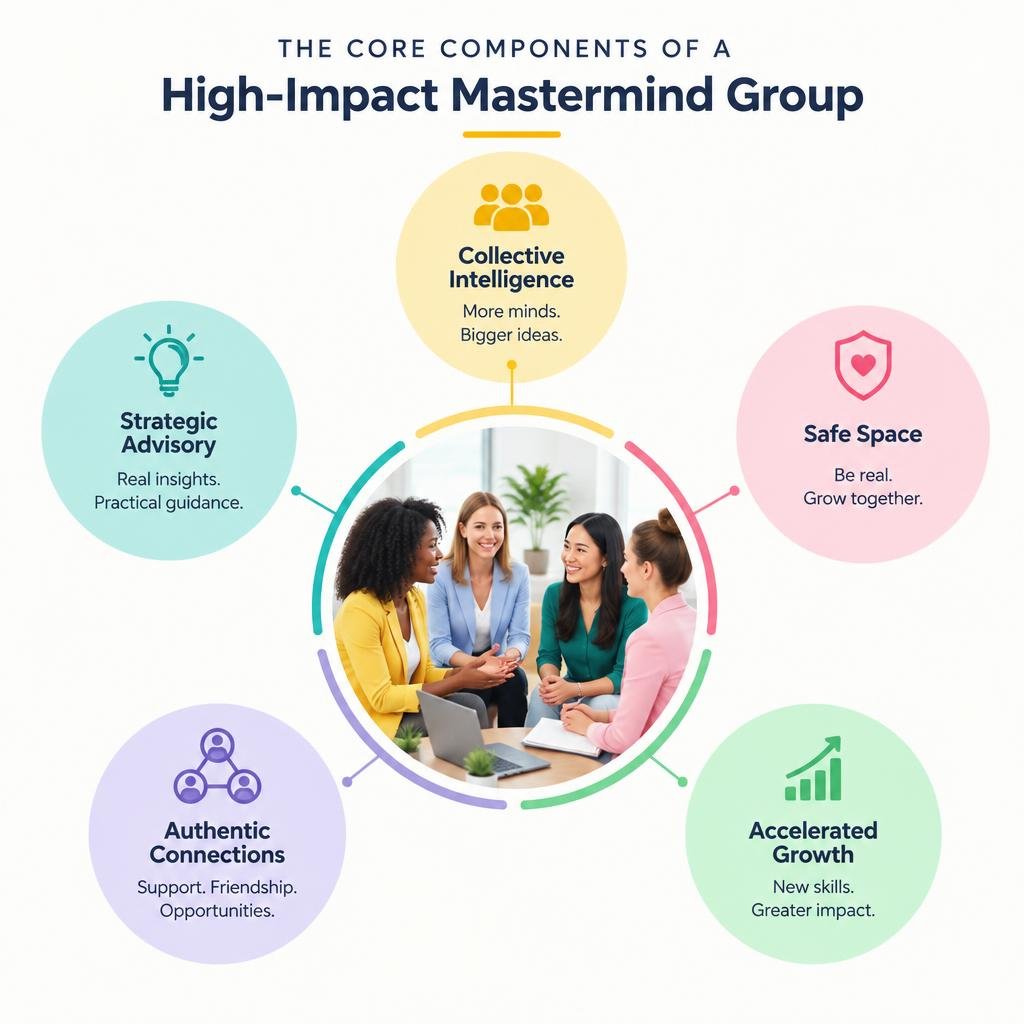
In today’s complex and rapidly changing business landscape, leaders face unprecedented challenges. From navigating global supply chain disruptions to fostering inclusive workplace cultures, the scope of leadership has broadened significantly. A Master of Science in Leadership (MSL) equips professionals with a robust theoretical framework, honing skills in strategic thinking, ethical decision-making, and organizational change. However, the true value of this academic rigor is often magnified when applied within a supportive, dynamic peer group. This is where a women’s mastermind community shines, offering collective intelligence, strategic advisory, a safe container for vulnerability, and authentic connection that complements formal education.
Imagine a scenario where you’ve just completed a demanding course on strategic management as part of your MSL program. You’ve absorbed theories on competitive advantage, market analysis, and resource allocation. A mastermind community provides the perfect crucible to test these theories, offering a platform where peers, who may also possess advanced degrees or extensive practical experience, can provide real-time feedback and diverse perspectives. This collective intelligence transforms abstract knowledge into actionable insights. It’s a space where your strategic advisory board is composed of high-caliber women who genuinely understand the nuances of leadership, providing insights that might not be covered in a textbook.
The concept of a “safe container” is crucial. Leadership, especially at executive levels, can be isolating. Mastermind groups cultivate an environment of trust and confidentiality, allowing members to share their deepest challenges, fears, and triumphs without judgment. This psychological safety fosters authentic connection, moving beyond superficial networking to build genuine relationships. For a leader who has invested in an MSL to enhance their ethical leadership and emotional intelligence, a mastermind provides a practical laboratory to apply these soft skills, receiving and giving transparent feedback that accelerates personal and professional growth.
Defining a Modern Women’s Mastermind Community
A modern women’s mastermind community is far more than a casual networking event; it is a meticulously structured peer advisory group designed for ambitious female leaders. Unlike traditional networking, which often focuses on transactional exchanges, masterminds prioritize deep, sustained collaboration and mutual growth.
At its core, a mastermind operates on structured accountability. Members commit to specific goals and report on their progress, creating a powerful external motivator. This discipline echoes the structured learning environment of an MSL, where coursework and deadlines drive consistent engagement. In an MSL program, you learn methodologies for strategic problem-solving, such as root-cause analysis and systems thinking. A mastermind provides a live arena to apply these methods to real-world business dilemmas, with peers offering fresh perspectives and challenging assumptions. For example, if you’re grappling with a complex organizational change initiative—a topic extensively covered in many MSL curricula—your mastermind peers can offer insights from their own experiences, helping you refine your approach.
Emotional intelligence is a cornerstone of effective leadership and a key competency developed in many MSL programs. Within a mastermind, this isn’t just theory; it’s practiced daily through active listening, empathetic feedback, and navigating group dynamics. The peer advisory aspect means you’re not just receiving advice from one mentor, but a diverse panel of experienced leaders, each bringing their unique background and expertise. This multi-faceted input is invaluable for leaders committed to continuous improvement.
To illustrate the distinction, consider this comparison:
Feature Traditional Networking Group Peer Mastermind Group Primary Goal Broad connections, lead generation, information exchange Deep collaboration, problem-solving, mutual growth, accountability Structure Informal, open-ended, event-based Structured meetings, defined agenda, consistent participation Relationship Depth Superficial, transactional Deep, trusting, long-term, confidential Accountability Minimal to none High, peer-driven, goal-oriented Focus External opportunities, general industry trends Internal challenges, strategic solutions, personal development Feedback General, often unsolicited, less critical Transparent, constructive, specific, actionable Time Commitment Variable, event-dependent Consistent, scheduled, significant Key Pillars: Accountability, Mentorship, and Perspective
The efficacy of a women’s mastermind community rests on three foundational pillars: accountability, mentorship, and diverse perspectives. These elements are not merely beneficial; they are transformative for leaders, particularly those who have invested in advanced education like an MSL.
Accountability in a mastermind is a powerful force for progress. When you articulate your goals to a group of committed peers, you dramatically increase your likelihood of achieving them. This isn’t about being policed; it’s about shared commitment and mutual support. For someone applying the strategic planning principles learned in an MSL, a mastermind ensures that these plans move beyond theory into tangible action. Members provide transparent feedback, offering honest assessments of your strategies and execution. This feedback loop is essential for blindspot discovery—identifying areas where your own assumptions or biases might be hindering progress. An MSL cultivates a rigorous analytical mindset, enabling you to perform root-cause analysis on organizational challenges. In a mastermind, peers can help validate your analysis or point out alternative root causes you may have overlooked, leading to more robust solutions.
While not formal mentorship in the traditional sense, the peer-to-peer guidance within a mastermind often functions as a dynamic mentorship network. Each member acts as both mentor and mentee, sharing their expertise and learning from others. This collective wisdom is particularly valuable for leaders navigating complex ethical dilemmas, a core focus of many MSL programs. Discussing such scenarios with a diverse group can illuminate different ethical frameworks and potential consequences, deepening your understanding and refining your decision-making process.
Finally, the diverse perspectives offered by a mastermind are invaluable. Members come from varied industries, roles, and backgrounds, bringing a rich tapestry of experiences to the table. This diversity ensures that problems are viewed from multiple angles, fostering innovative solutions and challenging conventional thinking. For leaders who have developed a strong foundational understanding of organizational behavior and change management through an MSL, the mastermind provides a real-world laboratory to observe and influence these dynamics across different contexts, ensuring strategic alignment not just within your own organization, but also aligning your personal leadership journey with broader industry trends and best practices.
Accelerating Professional Growth Through Curated Peer Networks
For women leaders, especially those who have pursued advanced degrees like a Master of Science in Leadership, the journey of professional growth is continuous. A curated peer network within a mastermind community acts as a powerful accelerator, translating academic knowledge and individual ambition into tangible career advancement and business impact. The collective wisdom and support within these groups facilitate operational scale, promote resource sharing, offer invaluable cross-functional insights, and build profound resilience.
Consider the challenge of scaling operations. An MSL program might teach you about process optimization, supply chain management, or organizational design. However, applying these concepts in a real-world, high-stakes environment can be daunting. In a mastermind, you can present your scaling strategy to peers who have successfully navigated similar growth phases. They can share practical advice on everything from technology implementation to talent acquisition, effectively providing a real-time, high-level consulting service. This resource sharing extends beyond advice to include introductions, vendor recommendations, and even shared lessons from failures, significantly reducing your learning curve and mitigating risks.
The cross-functional insights gained are particularly potent. While an MSL provides a holistic view of leadership, a mastermind group can bring together leaders from marketing, finance, technology, human resources, and operations. This diverse exposure allows you to understand how decisions in one area impact others, fostering a more integrated and strategic approach to leadership. For instance, a leader with an MSL in Industrial and Manufacturing Engineering might excel at process optimization but benefit immensely from a peer’s insights on human capital strategies for retaining skilled labor during expansion. This broadens your leadership perspective beyond your specific domain, making you a more versatile and effective executive.
These curated networks build resilience. Leadership is not without its setbacks and moments of self-doubt. Knowing you have a dedicated group of peers who understand your challenges, celebrate your successes, and offer unwavering support creates a psychological buffer against burnout and isolation. This collective strength empowers you to push boundaries, take calculated risks, and persevere through adversity, reinforcing the personal and professional development fostered by an MSL.
Integrating In-Person Immersions and the Women Leadership Retreat
While virtual connections are vital for ongoing support, the power of a women’s mastermind community is often amplified through integrating in-person immersions and dedicated leadership retreats. These focused gatherings provide an unparalleled environment for deep-dive strategy, fostering a high-trust environment, and delivering intensive experiential learning that complements the theoretical grounding of an MSL program, contributing to holistic development.
Imagine stepping away from the daily demands of your role, whether you’re a recent MSL graduate applying new theories or a seasoned executive. A leadership retreat offers an opportunity for uninterrupted ideation and strategic planning. These immersions are designed for deep-dive strategy sessions, allowing members to tackle complex challenges, refine business models, or develop long-term vision in a concentrated format. The high-trust environment cultivated over months of virtual mastermind sessions deepens during these retreats, leading to more candid discussions, more vulnerable sharing, and ultimately, more impactful breakthroughs.

Experiential learning is a hallmark of many progressive MSL programs, bridging the gap between academic theory and practical application. Leadership retreats extend this concept by providing immersive workshops, facilitated exercises, and real-time problem-solving scenarios. For example, a session on ethical decision-making, a core component of many MSL curricula, might involve a complex case study that the entire group dissects, offering diverse perspectives and practical frameworks for resolution. This isn’t just learning about leadership; it’s actively practicing it in a supportive, yet challenging, environment.
The holistic development fostered by these retreats is significant. Beyond business strategy, they often include elements focused on personal well-being, mindfulness, and work-life integration. For women leaders, who often juggle multiple roles and responsibilities, these components are crucial for sustained effectiveness. They reinforce the self-awareness and emotional intelligence cultivated in an MSL, ensuring that leaders are not only strategically astute but also personally resilient and balanced.
Why Female Founders Need a Specialized Advisory Board
Female founders, particularly those leveraging the strategic acumen gained from a Master of Science in Leadership, face a unique set of challenges and opportunities. A specialized advisory board, often manifested through a dedicated mastermind community, is not a luxury but a strategic imperative. Such a board can provide critical guidance on capital access, help navigate scaling hurdles, enhance executive decision-making, and improve talent retention.
Accessing capital remains a significant barrier for many female-led businesses. An advisory board composed of experienced female entrepreneurs and executives can provide invaluable insights into fundraising strategies, investor relations, and even direct introductions to capital sources. For a founder with an MSL, who understands financial modeling and strategic growth, the advisory board helps translate that knowledge into actionable funding proposals and pitches that resonate with investors.
Scaling a business introduces a myriad of complex hurdles, from operational inefficiencies to market expansion challenges. The strategic management and organizational change expertise developed through an MSL are foundational, but a mastermind offers a sounding board for these strategies. Peers can share their own experiences with rapid growth, offering practical advice on everything from building robust infrastructure to managing cash flow during expansion. This collective experience is crucial for mitigating risks and making informed decisions.
Executive decision-making is continuously refined within a mastermind. The rigorous analytical training of an MSL enables data-driven choices, but the diverse perspectives of an advisory board introduce nuances that data alone cannot capture. Whether it’s a critical hiring decision, a pivot in product strategy, or a response to a market disruption, discussing these with a group of trusted peers leads to more comprehensive and resilient outcomes. This peer-level scrutiny helps leaders avoid blind spots and consider unforeseen consequences.
Finally, talent retention is a constant battle in a competitive market. An MSL often covers human resource management and leadership development, providing tools for building strong teams. An advisory board can offer insights into innovative HR practices, compensation strategies, and culture-building initiatives that attract and retain top talent. They can also serve as a source of potential hires or provide references, further strengthening the founder’s ability to build a high-performing team. A mastermind community for female entrepreneurs acts as a powerful, dynamic advisory board, providing the strategic depth and practical support essential for sustained success.
Tangible Career and Business ROI from Peer Masterminds
Investing in a Master of Science in Leadership is a commitment to advanced professional development, promising enhanced career trajectories and greater impact. However, the theoretical knowledge and strategic frameworks gained from an MSL can achieve their highest return on investment (ROI) when actively applied and refined within a peer mastermind. These communities deliver tangible career and business ROI through fostering sustainable growth, enhancing executive presence, developing negotiation mastery, and enabling effective risk mitigation.
Sustainable growth is not merely about increasing revenue; it’s about building resilient systems and strategies that endure. An MSL provides the strategic foresight and ethical grounding necessary for long-term planning. Within a mastermind, these plans are subjected to rigorous peer review, identifying potential pitfalls and optimizing for efficiency and impact. Members share best practices for scaling operations responsibly, ensuring that growth is not only rapid but also robust and ethical, aligning with the values often emphasized in MSL programs. This collective intelligence helps leaders avoid common growth traps and build businesses that thrive for years to come.
Executive presence, often an intangible yet critical leadership trait, is significantly developed within a mastermind setting. Through consistent interaction, presenting challenges, receiving feedback, and leading discussions, members hone their communication skills, confidence, and gravitas. This practical application of leadership principles, learned in an MSL, helps translate academic understanding into authentic, impactful presence in boardrooms, client meetings, and public speaking engagements. The safe environment allows for experimentation and refinement, building the kind of leadership effectiveness that commands respect and inspires action.
Negotiation mastery is another area where masterminds provide invaluable practical experience. Whether it’s negotiating contracts, managing team conflicts, or advocating for resources, the ability to negotiate effectively is paramount for leaders. While an MSL might offer courses in conflict resolution and strategic communication, a mastermind provides real-time scenarios for role-playing, discussing negotiation tactics, and receiving feedback on your approach. This experiential learning accelerates the development of advanced negotiation skills, leading to better outcomes in business dealings and career advancement.
Finally, effective risk mitigation is a constant concern for any leader. An MSL equips professionals with analytical tools to assess risks and develop contingency plans. A mastermind amplifies this capability by offering diverse perspectives on potential threats and innovative solutions. Peers can identify risks you might overlook, share their own experiences with managing crises, and help you develop more comprehensive risk management strategies. This collective foresight significantly reduces exposure to potential setbacks, safeguarding both your career trajectory and your business’s stability.
Quantifiable Outcomes Inside a Women’s Mastermind Community
The value of a women’s mastermind community isn’t just anecdotal; it translates into quantifiable outcomes that directly impact business performance and leadership effectiveness. For leaders who have invested in an MSL, these groups provide a framework for measuring and accelerating the impact of their advanced education. We often see improvements in revenue scaling, leadership effectiveness, strategic expansion, and meticulous KPI tracking.
One of the most direct quantifiable outcomes is revenue scaling. Mastermind members frequently report significant increases in their business revenue, often attributed to the strategic advice, accountability, and innovative ideas generated within the group. For example, a leader who has learned strategic marketing principles in their MSL might present a new campaign idea to their mastermind. Peers, with their diverse industry experience, can offer feedback on market positioning, pricing strategies, or potential partnerships, leading to a more effective and profitable launch. The collective brainstorming and accountability ensure that these strategies are not only developed but also executed with precision.
Leadership effectiveness is another key metric. While an MSL provides the theoretical underpinnings for strong leadership, a mastermind offers a practical arena for continuous improvement. Members receive candid feedback on their communication style, decision-making processes, and team management techniques. This leads to measurable improvements in team performance, employee engagement, and overall organizational efficiency. Leaders learn to better leverage their MSL-acquired skills in areas like emotional intelligence and change management, translating into more productive and harmonious workplaces.
Strategic expansion, whether into new markets, product lines, or customer segments, is often a direct result of mastermind collaboration. The group acts as a strategic think tank, helping members evaluate opportunities, assess risks, and develop robust expansion plans. This is particularly valuable for leaders who have studied global leadership or strategic management in their MSL, as the mastermind provides diverse, real-world context to their theoretical knowledge. The shared insights and accountability ensure that expansion efforts are well-researched and executed effectively, leading to measurable market share gains or increased customer base.
Finally, masterminds foster meticulous KPI tracking. The emphasis on accountability naturally leads members to define and monitor key performance indicators more diligently. Whether it’s tracking conversion rates, customer lifetime value, employee retention, or project completion rates, the group encourages a data-driven approach to leadership. This aligns perfectly with the analytical rigor often instilled by an MSL, ensuring that decisions are based on evidence and that progress is continually measured and optimized.
Navigating Complex Transitions and Organizational Scaling
The modern business environment is characterized by constant flux, making the ability to navigate complex transitions and organizational scaling a critical leadership competency. A Master of Science in Leadership equips professionals with frameworks for change management, ethical governance, and understanding team dynamics. However, the practical application of these theories during high-stakes transitions is profoundly enhanced by the collective wisdom and support found within a women’s mastermind community.
Change management, a core component of many MSL programs, becomes less theoretical and more actionable within a mastermind. When faced with a significant organizational restructuring, a technology overhaul, or a shift in company culture, a leader can present their change strategy to the group. Peers, drawing from their own experiences with similar transformations, can offer insights into potential resistance points, communication strategies, and methods for fostering buy-in. This collaborative approach helps leaders refine their implementation plans, ensuring smoother transitions and greater success rates.
Ethical governance is paramount during periods of growth and transition. An MSL instills a strong ethical compass and frameworks for responsible decision-making. In a mastermind, leaders can discuss complex ethical dilemmas that arise during scaling—such as balancing profit with social responsibility, ensuring fair labor practices in new markets, or maintaining data privacy with new technologies. The diverse perspectives within the group can illuminate different ethical considerations and help formulate robust governance policies that align with both business objectives and moral principles. This peer review strengthens the leader’s ability to uphold integrity amidst pressure.
Operational resilience is tested during scaling. An MSL might teach about supply chain optimization or risk management, but a mastermind offers real-world stress testing of these concepts. Peers can share strategies for building robust operational frameworks, diversifying revenue streams, and creating agile teams that can adapt quickly to unforeseen challenges. This collective experience helps leaders anticipate potential disruptions and build systems that can withstand shocks, ensuring business continuity during periods of rapid change.
Moreover, understanding and influencing team dynamics is crucial. As organizations scale, team structures evolve, and new challenges in communication and collaboration emerge. An MSL provides insights into group psychology and leadership styles. A mastermind offers a safe space to discuss team conflicts, motivate diverse workforces, and build cohesive high-performing teams. Members can share strategies for fostering psychological safety, promoting inclusive practices, and developing leadership within their own teams, directly applying and refining the knowledge gained from their advanced degrees. This continuous peer learning helps cultivate a strong organizational culture that supports growth and adaptability.
Frequently Asked Questions About Women’s Masterminds
As we’ve explored the profound benefits of women’s mastermind communities, particularly for leaders with a Master of Science in Leadership, several common questions arise regarding their structure, participation, and outcomes. We aim to address these to provide clarity for those considering joining such a transformative group.
What distinguishes a mastermind community from typical networking groups?
The fundamental difference lies in their purpose, structure, and depth of engagement. Typical networking groups are often broad, focusing on meeting many people, exchanging business cards, and perhaps generating leads. They tend to be less structured, with varying levels of commitment from participants. The interactions are often superficial and transactional.
In contrast, a mastermind community operates with a structured cadence and a clear agenda. It’s a curated group of individuals, typically around 8-12 members, who commit to regular, often bi-weekly or monthly, meetings. The core distinction is deep accountability; members share specific goals, challenges, and progress, and the group holds them accountable. This fosters psychological safety, allowing for vulnerable and transparent discussions that go far beyond surface-level interactions. For someone with an MSL, the structured problem-solving and sustained collaboration within a mastermind offer a practical extension of their academic rigor, providing real-world application for their strategic thinking and ethical frameworks. It’s a place for sustained, impactful collaboration rather than fleeting connections.
How do leadership retreats enhance mastermind group impact?
Leadership retreats serve as intensive, immersive accelerators that significantly deepen the impact of regular mastermind sessions. While virtual meetings provide consistent support, retreats offer an opportunity to step away from daily distractions and engage in focused, in-depth work.
The primary enhancements include immersive focus and authentic bonding. By spending concentrated time together, members develop stronger personal connections, which translates into increased trust and psychological safety within the group. This allows for more candid feedback, deeper vulnerability, and a more profound understanding of each other’s challenges and aspirations.
Furthermore, retreats facilitate strategic alignment and uninterrupted ideation. With dedicated blocks of time, groups can engage in deep-dive strategy sessions, tackle complex problems that require extended discussion, or collectively brainstorm innovative solutions without interruption. This environment is ideal for leaders to apply the holistic development and strategic management skills cultivated through an MSL, translating theoretical knowledge into actionable, high-impact plans. It’s an opportunity for experiential learning on a grander scale, where theories are tested, refined, and cemented through shared experience and focused collaboration.
Who is the ideal candidate for an executive-level women’s mastermind?
The ideal candidate for an executive-level women’s mastermind is a growth-minded, ambitious professional deeply committed to continuous learning and making a significant impact. This often includes female founders scaling their businesses, C-suite executives navigating complex organizational landscapes, senior managers poised for executive leadership, and ambitious innovators driving change within their industries.
Crucially, these individuals are typically beyond entry-level roles and possess a foundational understanding of leadership principles. Many have already invested in their professional development through advanced degrees like a Master of Science in Leadership, which provides them with a strong framework in strategic thinking, ethical decision-making, and organizational dynamics. They are looking for a peer group that can challenge them, support them, and help them apply their advanced knowledge to real-world scenarios.
An ideal candidate is someone who:
- Is growth-oriented: Actively seeking to expand their skills, influence, and business.
- Values collaboration: Understands the power of collective intelligence and peer support.
- Is willing to be vulnerable: Prepared to share challenges and receive constructive feedback.
- Has a track record of achievement: Brings valuable experience and insights to the group.
- Is committed to accountability: Ready to set goals and be held responsible for achieving them.
It’s for the leader who recognizes that while an MSL provides the map, a mastermind provides the seasoned guides and fellow travelers to navigate the most challenging terrains of their professional journey.
Conclusion
The journey of leadership is multifaceted, demanding continuous growth, strategic acumen, and unwavering support. While a Master of Science in Leadership provides an indispensable academic foundation, equipping professionals with critical strategic, ethical, and organizational insights, its true potential is often unlocked and amplified through real-world application and peer collaboration. Women’s mastermind communities serve as powerful catalysts in this journey, offering a unique blend of collective intelligence, strategic advisory, and authentic connection that traditional education alone cannot provide.
From fostering structured accountability and strategic problem-solving to building resilience and enhancing executive presence, these communities offer tangible ROI for both career and business. They bridge the gap between theory and practice, providing a safe container for leaders to refine their skills, discover blind spots, and navigate complex transitions with confidence. Through immersive retreats and ongoing peer support, members experience holistic development, transforming their leadership effectiveness and driving sustainable growth.
For the ambitious female leader, whether a founder, a C-suite executive, or a senior manager, an executive-level women’s mastermind is not merely a networking opportunity; it is a strategic imperative. It’s where the intellectual rigor of an MSL meets the practical wisdom of experienced peers, leading to unparalleled collective elevation and ongoing transformation. By embracing such a community, leaders gain strategic clarity and cultivate the purposeful leadership necessary to thrive in an ever-evolving world.
More business and networking tips:
- Planning For Your First Networking Conference
- Top Digital Business Ideas for Moms Who Want to Earn Money from the Comfort of Their Home
- Expert Tips for Setting Up a Successful Business
