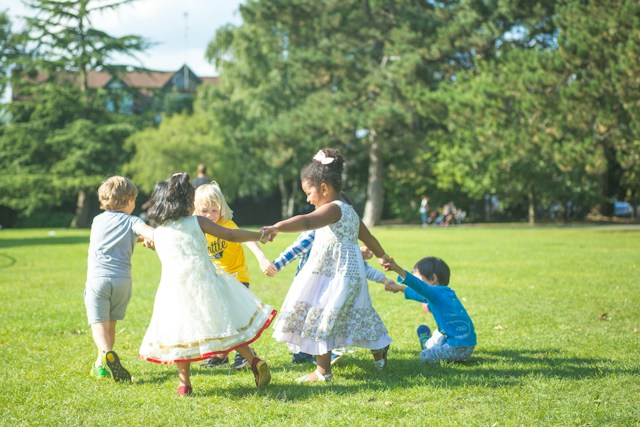
Image Credit: Unsplash
Young children learn best when they can touch, test, imagine, and explore. Play-based learning turns that natural curiosity into meaningful experiences, helping children understand new ideas while staying engaged.
This approach can look simple from the outside, yet every block tower, pretend café, and backyard discovery offers opportunities to practice language, reasoning, and cooperation. As explored in the power of play, playful experiences also support development across several areas at once. Children gain knowledge while building the confidence to try, adjust, and try again.
Defining Play-Based Education
Play-based education gives children room to make choices within an environment designed for learning. Activities may be child-led, guided by an educator, or a blend of both. A teacher might place measuring cups beside a water table, for example, then introduce words such as “full,” “empty,” and “half” as children experiment.
Families comparing preschools can look for accessible materials, inviting activity areas, and educators who join play without controlling every decision. The Institute of Education Sciences explains that play-based learning can include free play, guided play, and structured games. Each format serves a purpose, provided children remain active participants in the experience.
Developing Key Skills Through Play
A single play session can support several developmental goals. Building a bridge from blocks strengthens fine motor control and introduces balance, shape, and basic engineering ideas. When the bridge collapses, children practice persistence as they reconsider its design.
Pretend play develops language and social understanding. Children running an imaginary grocery store take turns, negotiate roles, count items, and explain what they need. Outdoor games strengthen coordination while teaching children to follow directions and respond to others.
Current play-based learning trends also highlight creativity, collaboration, and problem-solving. Parents can support these skills by asking open prompts such as “What could you try next?” or “How did you decide where that piece should go?” These questions encourage reflection without taking ownership of the activity.
The Role of Educators in Play
Educators shape playful learning through careful observation and thoughtful preparation. They watch what captures a child’s attention, then offer materials or prompts that extend the idea. If children are fascinated by toy animals, an educator might add books, natural materials, and sorting trays to introduce habitats, textures, and categories.
Timing matters. Adults should step in when a child needs new vocabulary, help resolving a disagreement, or a manageable challenge. At other moments, quiet observation gives children space to work things out.
Documentation also guides teaching. Notes, photographs and samples of children’s work can reveal changes in communication, concentration and physical control. Educators can then plan experiences that respond to each child’s development instead of relying only on age-based expectations.
Bringing Playful Learning Home
You don’t need specialized toys to create useful learning experiences at home. Cardboard boxes can become houses, buses, or shops. Socks can be sorted by color and size, while meal preparation offers chances to count spoonfuls, compare ingredients, and follow a sequence.
Set out a small selection of open-ended materials, such as paper, washable crayons, blocks, and reusable containers. Too many choices may make it harder for a young child to settle into focused play. Rotating a few materials every week can renew interest without requiring frequent purchases.
Follow your child’s attention and add one gentle challenge. If a toddler stacks three cups, offer a fourth. If an older child creates a pretend restaurant, invite them to draw a menu or count place settings. The best playful learning often begins with an ordinary object and enough uninterrupted time to discover what it can become.
A blanket fort, a row of toy animals, or a bowl of water can hold far more learning than its materials suggest. What matters most is a child who feels safe to experiment and an adult who notices when to offer a word, a question, or simply more time.
More tips on learning through play:
