The Foundation of Joint and Foot Mobility Across the Kinetic Chain
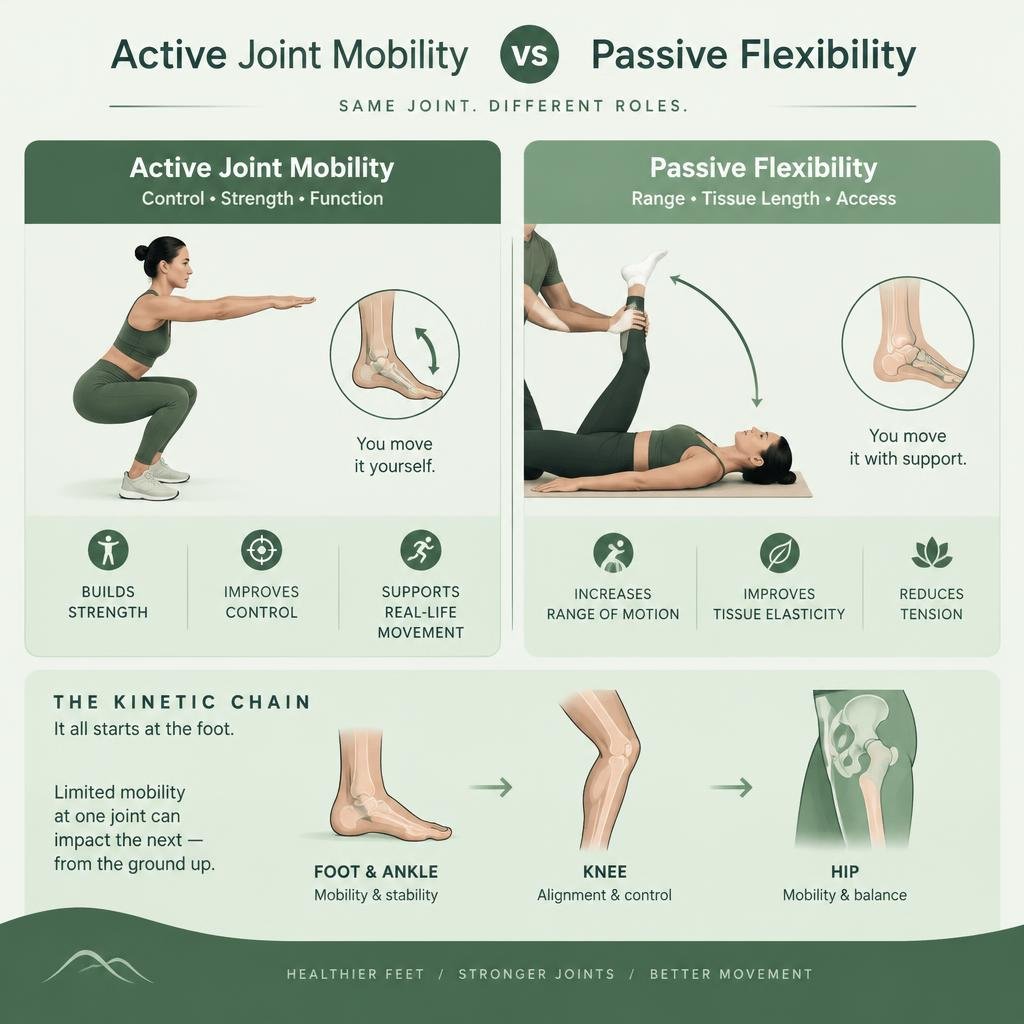
Our bodies are intricate systems, and nowhere is this more evident than in the kinetic chain – the interconnected system of joints, muscles, and fascia that work in harmony to produce movement. When we talk about joint and foot mobility, we’re not just isolating individual parts; we’re considering how each segment influences the next, from the ground up.
The talocrural joint, or ankle, plays a pivotal role in this chain. Its ability to move freely, particularly in dorsiflexion (lifting the foot towards the shin), directly impacts the mechanics of the knee and hip during activities like walking, squatting, and climbing stairs. Limited ankle mobility can force compensatory movements higher up the chain, leading to issues like knee valgus (knees caving inward) or excessive hip internal rotation, which can contribute to pain and injury over time.
Biomechanics are key here. Our weight distribution and postural alignment are constantly being adjusted by the subtle interplay of forces throughout the kinetic chain. When a joint lacks its full, controlled range of motion, the nervous system often responds by “shutting down” surrounding muscles, a phenomenon known as arthrogenic inhibition. This can lead to weakness and instability, perpetuating a cycle of dysfunction.
Understanding the distinction between active joint mobility and passive flexibility is crucial for effective training. While both involve range of motion, their implications for functional movement and injury prevention differ significantly.
Foot Mechanics and the Upstream Impact on Knees and Hips
The foot, often overlooked, is a marvel of engineering. Its complex structure, involving 26 bones and numerous small intrinsic muscles, is designed to adapt to varied terrain, absorb shock, and propel us forward. However, modern lifestyles, characterized by supportive shoes and sedentary habits, often diminish the natural strength and mobility of these crucial structures.
Consider ankle dorsiflexion. Research, including studies up to 2026, consistently highlights its importance. Insufficient ankle dorsiflexion can lead to a cascade of problems. During a squat, for instance, if the ankle cannot adequately flex, the body compensates by shifting weight forward, rounding the back, or allowing the knees to collapse inward. This places undue stress on the knee joint and can alter hip mechanics, potentially contributing to conditions like patellofemoral pain syndrome or even hip impingement over time.
Furthermore, the strength and control of the foot intrinsic muscles are vital. These small muscles help maintain the arch of the foot and provide proprioceptive feedback, informing the brain about foot position. Weakness in these muscles can contribute to pes planus, or flat feet, which can again alter the gait cycle and transmit abnormal forces up the kinetic chain to the knees and hips. Effective foot mobility training, therefore, involves not just stretching, but also strengthening these intrinsic muscles and improving toe control. For those experiencing persistent issues with their lower extremities, seeking specialized foot and ankle medical care can provide tailored diagnoses and treatment plans to address these foundational problems.
Active Mobility Versus Passive Flexibility in Joint Health
While often used interchangeably, mobility and flexibility are distinct concepts, and understanding their difference is fundamental to optimizing joint health.
- Passive Flexibility refers to the range of motion a joint can achieve when an external force is applied, such as gravity, a partner, or a stretching strap. It’s about how far a joint can go. Think of a gymnast holding a split with assistance – that’s passive flexibility.
- Active Mobility, on the other hand, is the ability to move a joint through its full range of motion under its own muscular control. It combines flexibility with strength, coordination, and neuromuscular control at the end ranges of motion. If that same gymnast can perform a split without any assistance, that demonstrates active mobility.
Why does this distinction matter? Because true functional movement relies on active mobility. You might be able to passively stretch your hamstring to touch your toes, but if you lack the active control and strength to lift your leg high without assistance, that passive range isn’t truly “yours” for functional tasks.
Active mobility drills work by teaching the nervous system to “own” each degree of motion. They involve moving the joint through its full available range, often with a slight pause or contraction at the end point. This process warms the joint capsule, stimulates the production of synovial fluid (the natural lubricant for our joints), and enhances proprioception – our body’s sense of its position in space. By engaging the muscles that control the movement, we build end-range strength, which is critical for joint stability and preventing injury. This motor learning is a key component that static stretching often misses.
Evidence-Based Self-Mobilization and Movement Protocols
The pursuit of better joint mobility isn’t just about feeling good; it’s backed by a growing body of scientific research. Self-administered joint mobilization techniques, in particular, have gained traction as effective tools for restoring range of motion, reducing pain, and improving functional movement. These techniques often involve applying gentle, sustained glides or oscillations to a joint while performing an active movement.

These methods, often inspired by manual therapy approaches like the Mulligan concept of Mobilization with Movement (MWM), aim to restore normal joint mechanics. They can help improve tissue compliance, reduce shear stress on joint surfaces, and normalize afferent input (signals from the joint to the brain), which can immediately reduce pain and improve muscle activation.
Lower-Body Self-Mobilization for Joint and Foot Mobility
Targeting the lower body – specifically the ankles, knees, and hips – with self-mobilization techniques can yield significant benefits for overall movement and pain reduction. Here are some examples of techniques that can be incorporated into your routine:
- Talocrural Glide (Banded Ankle Dorsiflexion): Using a resistance band anchored to a stable object, loop it around the front of your ankle just above the foot. Step back to create tension and drive your knee forward over your toes, keeping your heel on the ground. This helps to mobilize the talus bone, improving ankle dorsiflexion.
- Hip Internal Rotation Mobilization: Lie on your back with knees bent and feet flat. Let one knee fall inward towards the midline while keeping the other knee upright. You can gently assist the internal rotation by applying light pressure to the outside of the knee. This addresses common stiffness in hip internal rotation, crucial for walking and squatting.
- Tibiofemoral Distraction (Knee): While more challenging to self-administer, a gentle form involves sitting on the floor with legs extended and placing a rolled towel or foam roller behind the knee. Then, gently press down on the thigh, creating a slight gapping sensation in the knee joint. This can help decompress the joint.
- PNF Stretching (Proprioceptive Neuromuscular Facilitation): This technique involves contracting a muscle before stretching it, which can “trick” the nervous system into allowing a deeper stretch. For example, for hamstrings, contract your hamstrings against resistance for 5-10 seconds, then immediately relax and stretch further.
- Toe Splay and Control: Practicing spreading your toes wide and then individually lifting and lowering them can significantly improve the strength and coordination of your foot intrinsic muscles. This directly supports arch integrity and balance.
- Plantar Fascia Release: Using a small ball (like a golf ball or lacrosse ball), roll the sole of your foot over it, applying gentle pressure. This can help release tension in the plantar fascia, which is often linked to foot pain and can impact overall foot mechanics.
Self-administered joint mobilization techniques have been shown to have an immediate effect on assessed muscle weakness, improving muscle activity and muscle strength during functional activity. This suggests that by restoring proper joint mechanics, we empower our muscles to work more efficiently.
Clinical Evidence on Mobilization with Movement for Knee Osteoarthritis
Knee osteoarthritis (OA) is a prevalent condition, particularly among adults over 50, characterized by pain, stiffness, and functional limitations. Traditional management often includes exercise and pain medication. However, recent research, including a notable 2026 Randomized Controlled Trial (RCT), has shed light on the powerful combination of manual therapy and exercise.
The 2026 RCT on Mobilization with Movement (MWM) for knee osteoarthritis demonstrated compelling results. Participants who received MWM in addition to isometric training showed significantly faster and larger improvements in pain (VAS scores), quadriceps strength (STN), and disability (WOMAC index) over six weeks, compared to those receiving isometric training alone. The study reported impressive Group×Time interaction effects of ηp² = 0.532 for pain, ηp² = 0.577 for strength, and ηp² = 0.321 for disability (all p < 0.0001).
This research highlights that MWM, which involves a sustained accessory glide applied by a therapist while the patient actively moves the joint in a pain-free direction, can be a game-changer. It suggests that addressing joint mobility directly, alongside strengthening exercises, helps to break the cycle of pain and inhibition often seen in OA. The immediate pain reduction provided by MWM can facilitate greater adherence to exercise programs, accelerating recovery and improving functional outcomes.
Quadriceps weakness is a well-established risk factor for the onset and progression of knee osteoarthritis and contributes significantly to functional limitations. By combining MWM with isometric quadriceps exercises, patients can overcome arthrogenic inhibition more effectively, leading to quicker strength gains and pain relief. This integrated approach offers a promising pathway for enhancing early rehabilitation outcomes in knee OA. For individuals managing osteoarthritis, supporting joint health with comprehensive strategies can be beneficial. Some people find that crystalline glucosamine sulfate supplements, often used to support cartilage health, can be a valuable addition to their overall regimen, though it’s always wise to discuss such additions with a healthcare professional.
A Structured 15-Minute Daily Lower Body Mobility Routine
Consistency is paramount when it comes to improving joint mobility. A short, structured daily routine can be far more effective than infrequent, intense sessions. Our goal is to warm the joint capsule, lubricate cartilage with synovial fluid, and teach the nervous system to “own” each degree of motion. This routine is designed to be joint-friendly, making it suitable for individuals with arthritis, joint pain, or stiffness, with appropriate modifications.
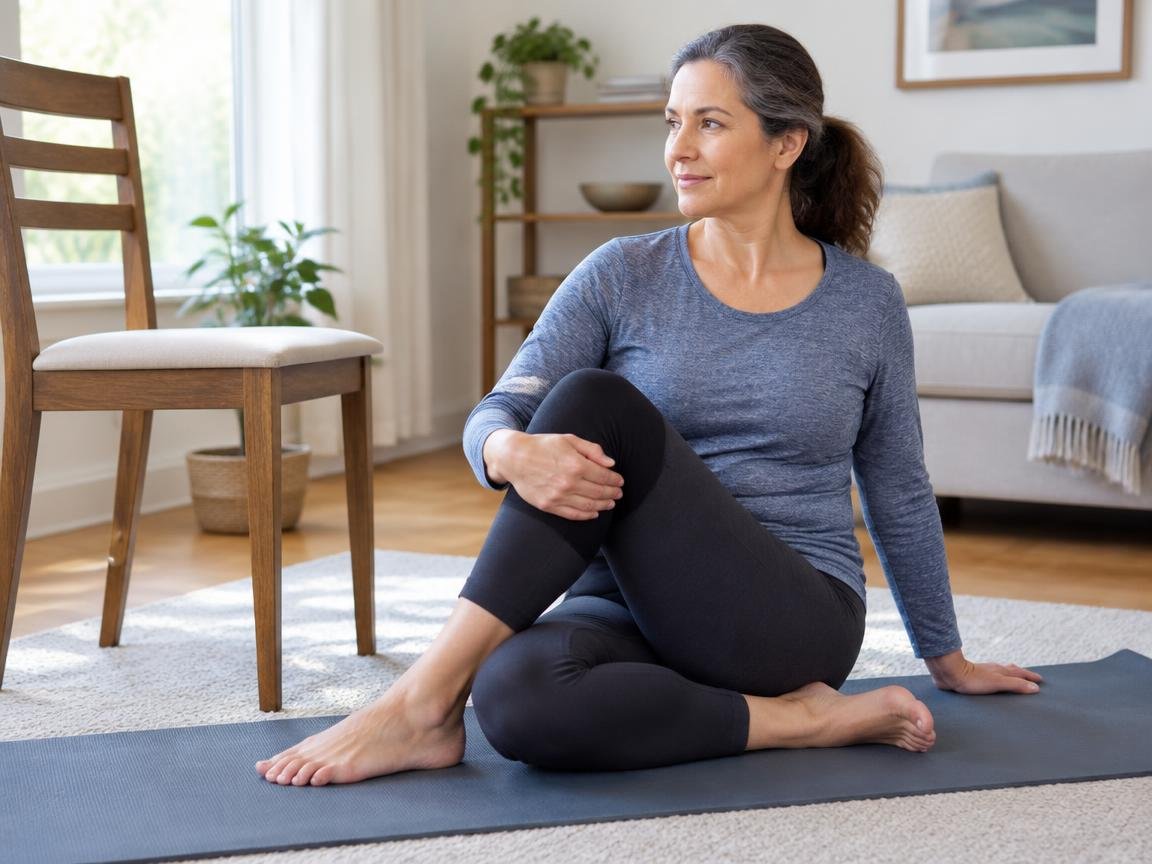
Most people notice easier movement within 2-3 weeks and meaningful range-of-motion gains by week 6 when performing a 15-minute joint-friendly mobility routine 3-5 times per week. A 15-minute mobility session often reduces stiffness faster than the same time spent stretching, as it actively engages the joint through its range.
Five-Phase Flow from Ankle Preparation to Hip Integration
This 15-minute routine focuses on the lower body, progressing through key joints to ensure comprehensive coverage. Remember to move slowly, breathe deeply, and stay within a pain-free range.
Warm-Up (2 minutes):
- Gentle Marching in Place: 1 minute, focusing on lifting knees and swinging arms.
- Ankle Circles: 30 seconds each ankle, clockwise and counter-clockwise.
Phase 1: Ankle & Foot Focus (4 minutes)
- Ankle Rocks (Kneeling): Kneel on the floor, one foot flat on the ground in front of you. Gently rock your torso forward, driving your knee over your toes while keeping your heel down. Feel the stretch in your ankle. Perform for 1 minute per side.
- Seated Toe Splay & Lift: Sit in a chair with feet flat. Practice spreading your toes as wide as possible, then try to lift just your big toe, then just your four smaller toes. Alternate for 2 minutes total. This strengthens intrinsic foot muscles.
Phase 2: Knee & Hip Preparation (4 minutes)
- Seated Leg Extensions: Sit tall in a chair. Slowly extend one leg forward, engaging your quadriceps, then slowly lower it. Focus on smooth, controlled movement, not speed. Perform for 1 minute per leg.
- 90-90 Hip Transitions (Controlled Articular Rotations – CARs): Sit on the floor with both knees bent at 90 degrees, one leg internally rotated (shin parallel to torso), the other externally rotated (shin perpendicular to torso). Slowly transition from one side to the other, maintaining an upright posture. This mobilizes the hip capsule. Perform for 2 minutes, flowing smoothly.
Phase 3: Deep Hip Integration (3 minutes)
- Wall Ankle Drive with Hip Flexion: Stand facing a wall, about a foot away. Place hands on the wall. Drive one knee up towards your chest (hip flexion), keeping your foot dorsiflexed. As you do this, also push the foot of your standing leg into the ground, engaging the hip and glute. This integrates ankle mobility with hip flexion. Perform for 1.5 minutes per side.
Phase 4: Full-Body Integration & Spinal Mobility (2 minutes)
- Quadruped Thoracic Openers: Start on hands and knees. Place one hand behind your head. Rotate your elbow towards the ceiling, opening your chest, then bring it back down towards your other elbow. This improves thoracic spine rotation, which influences shoulder and hip mechanics. Perform for 1 minute per side.
Integrating Joint and Foot Mobility into Strength and Daily Training
Mobility work isn’t a standalone activity; it should complement your broader fitness and daily life.
- Dynamic Warm-Up: Begin your workouts with 5-10 minutes of dynamic mobility drills, such as leg swings, hip circles, and spinal twists. This prepares your joints for movement, increases blood flow, and activates your nervous system.
- Intra-Set Mobility: During rest periods between sets of strength training, perform a quick mobility drill for the next body part you’ll be working. For example, between squat sets, do some ankle rocks or hip CARs. This can help maintain range of motion and improve performance.
- Cool-Down Routines: End your workouts with 5-10 minutes of gentle, longer-held mobility exercises or stretches. This helps to restore resting length to muscles and gradually brings your heart rate down.
- Rest-Day Recovery: Dedicate rest days to longer, more comprehensive mobility sessions. This is an excellent opportunity to focus on areas of stiffness or limitation without the fatigue of strength training.
- Movement Efficiency in Daily Life: The ultimate goal is to translate improved mobility into better functional movement. Pay attention to your posture, how you sit, stand, and walk throughout the day. Incorporate micro-mobility breaks – a few ankle circles at your desk, a hip hinge to pick something up – to counteract prolonged static positions.
By consistently integrating mobility work, you’ll not only enhance your performance in the gym but also improve your movement longevity and overall quality of life.
Common Mobility Mistakes and Safe Progression Guidelines
While mobility work is generally safe and beneficial, certain pitfalls can hinder progress or even lead to injury. Awareness of these common mistakes and adherence to safe progression guidelines are crucial for a successful mobility journey.

Common Mistakes:
- Treating Mobility Like a Workout: Mobility is about control and range, not intensity or speed. Rushing through movements, forcing ranges, or trying to “feel the burn” can be counterproductive and lead to injury.
- Ignoring Pain Signals: Sharp, pinching, or radiating pain is a red flag. Mobility work should always be pain-free. Pushing through pain can exacerbate existing issues or create new ones.
- Skipping the Warm-Up: Jumping straight into deep mobility drills without a gentle warm-up can strain cold tissues and joints. A few minutes of light cardio and dynamic movements prepare the body.
- Inconsistency: Mobility improvements are built through regular, consistent practice. Sporadic, intense sessions are less effective than shorter, daily routines.
- Focusing Only on Flexibility, Not Control: As discussed, passive flexibility without active control is not true mobility. If you can only achieve a range with external assistance but can’t hold it or move into it actively, you’re missing a key component.
- Compensating with Other Joints: When one joint is stiff, the body often finds ways to “cheat” by moving from an adjacent, more mobile joint. For example, if your hips are tight, you might round your lower back during a squat. Learning to isolate joint movements is key.
- Overdoing It (Hypermobility): While rare, some individuals have naturally hypermobile joints. For them, the focus should shift from increasing range to building stability and strength within their existing range to prevent injury.
Safe Progression Guidelines:
- Listen to Your Body: This is the golden rule. Always stay within your pain-free range of motion. If a movement causes discomfort, reduce the range or modify the exercise.
- Start Small, Be Consistent: Begin with a few minutes each day, focusing on one or two problem areas. Gradually increase duration and variety as your body adapts.
- Use Support: A chair, wall, or even a yoga block can provide support and help unload joints, allowing you to explore new ranges safely.
- Breathe: Deep, controlled breathing helps relax muscles and facilitates movement. Don’t hold your breath.
- Track Your Benchmarks: Periodically reassess your range of motion (e.g., squat depth, overhead reach) to see your progress. This can be done by filming yourself or simply noting how movements feel. Most people will see measurable gains in range of motion by week 6 with consistent practice.
- Seek Professional Guidance: If you have persistent pain, a recent injury, or a specific medical condition, consult a physical therapist or other qualified healthcare professional. They can provide a personalized assessment and tailor a mobility program to your needs.
By avoiding common mistakes and following these guidelines, you can safely and effectively improve your joint and foot mobility, leading to a more comfortable and functional life.
Frequently Asked Questions About Lower Body Joint Health
Many people have questions about how to best approach mobility work, especially when dealing with existing pain or stiffness. Here, we address some common concerns based on current understanding and research up to September 2026.
How quickly can consistent mobility training improve joint stiffness and pain?
The timeline for improvement can vary based on individual factors such as the severity of stiffness, underlying conditions, and consistency of practice. However, most people experience noticeable changes relatively quickly.
- Initial Relief (2-3 weeks): Many individuals report feeling less morning stiffness and easier movement within 2-3 weeks of starting a consistent 15-minute joint-friendly mobility routine, performed 3-5 times per week. This initial improvement is often due to increased synovial fluid circulation, neural adaptation, and reduced muscle guarding.
- Meaningful Gains (6-8 weeks): Measurable improvements in range of motion and significant pain reduction typically become evident by week 6 to 8. This is when the body has had enough time to adapt structurally (e.g., changes in connective tissue compliance) and neurologically (motor learning, improved control).
- Long-Term Benefits: Sustained practice leads to lasting changes, improving movement longevity and reducing the likelihood of chronic stiffness returning. Gentle, consistent mobility work is one of the most-recommended non-medication strategies for chronic knee and shoulder discomfort tied to stiffness, inactivity, or mild arthritis.
Consistency truly is the key. Short, regular sessions are more effective than infrequent, intense ones for long-term adaptation.
Can mobility drills reduce crepitus and discomfort in creaky knees?
Creaky knees, characterized by sounds like popping, clicking, or grinding (known as crepitus), are a common concern. While crepitus itself is often benign (often just gas bubbles releasing in the joint), if it’s accompanied by pain or discomfort, mobility drills can indeed be beneficial.
- Cartilage Lubrication: Gentle, controlled mobility drills encourage the production and circulation of synovial fluid within the knee joint. Synovial fluid acts as a lubricant, reducing friction between joint surfaces and nourishing the cartilage. This can help alleviate discomfort and potentially reduce the sounds associated with crepitus.
- Improved Patellar Tracking: Often, creaky knees are linked to imbalances in the muscles surrounding the knee, particularly the quadriceps, leading to poor patellar (kneecap) tracking. Mobility exercises that focus on hip mobility, ankle dorsiflexion, and balanced quadriceps activation can help improve the alignment and movement of the kneecap, reducing grinding sensations.
- Isometric Loading: Incorporating isometric exercises (muscle contractions without joint movement) can be particularly helpful for creaky knees. A five-week isometric quadriceps program, for instance, has been shown to significantly improve quadriceps strength, pain, and WOMAC scores in knee osteoarthritis patients. This type of loading can strengthen the muscles around the joint without excessive movement, reducing discomfort.
While mobility drills can significantly help manage discomfort and improve function in creaky knees, they are not a cure for structural damage. Always perform exercises within a pain-free range, and if pain persists or worsens, consult a healthcare professional.
What should I do if a specific mobility exercise causes sharp pain?
Experiencing sharp pain during a mobility exercise is a clear signal from your body that something is wrong, and it should never be ignored. Unlike the mild stretch sensation you might feel, sharp pain indicates potential irritation, impingement, or injury.
Here’s what to do:
- Stop Immediately: Discontinue the specific exercise or movement that caused the sharp pain. Do not try to push through it.
- Regress the Movement:Reduce Range of Motion: Try performing the movement through a smaller, pain-free range. Sometimes, just a slight adjustment in the angle or depth can eliminate the pain.
- Modify the Exercise: Can you perform a similar movement in a different position? For example, if a standing hip mobility drill causes pain, try it lying down or seated to reduce the load.
- Add Support: Use a wall, chair, or prop to support the joint and unload it. This can sometimes allow for pain-free movement.
- Rest and Reassess: Give the area a short break (a day or two) and then gently re-evaluate the movement. If the pain persists or returns immediately, it’s time to seek professional advice.
- Clinical Consultation: If the sharp pain is persistent, severe, accompanied by swelling, instability, or significantly limits your daily activities, it is crucial to consult a physical therapist, doctor, or other qualified healthcare professional. They can accurately diagnose the issue, rule out serious injury, and provide a personalized treatment plan. Self-diagnosis and continued self-treatment of sharp pain can delay recovery or worsen the condition.
The goal of mobility work is to improve movement and reduce pain, not to cause it. Listening to your body and respecting its pain signals is the safest and most effective approach.
Conclusion
In our journey through the intricate world of joint and foot mobility, we’ve uncovered its profound impact on our daily lives, from the ground-up mechanics of the kinetic chain to the latest research guiding our strategies. We’ve learned that true mobility extends beyond passive flexibility, encompassing active control, strength, and neurological coordination.
By understanding the vital role of the ankles, knees, hips, and shoulders, and recognizing how foot mechanics can influence the entire lower body, we gain powerful insights into preventing injury and enhancing performance. The evidence, including cutting-edge research from 2026, strongly supports the integration of self-administered joint mobilization techniques, particularly for conditions like knee osteoarthritis, demonstrating significant improvements in pain, strength, and function.
We’ve also provided a practical, 15-minute, joint-friendly mobility routine, designed to be safe and effective for various individuals, including those with arthritis or stiffness. This routine, when performed consistently 3-5 times a week, promises measurable improvements in movement ease within weeks and significant gains in range of motion by week six.
Avoiding common mistakes like pushing through pain or neglecting consistency is paramount for safe and effective progression. Instead, by listening to our bodies, starting gradually, and seeking professional guidance when needed, we can cultivate a sustainable mobility practice.
Embracing joint and foot mobility as a daily habit is an investment in your functional independence and movement longevity. It’s about optimizing your body’s natural ability to move freely, reducing discomfort, and safeguarding the integrity of your joints for years to come. By consciously engaging your nervous system and nurturing your joints, you’re not just moving better; you’re living better.
Related posts:
- How To Overcome Joint Pain And Sore Muscles
- 5 lifestyle factors (you didn’t know) that increase your risk for back pain
- Why Do People Prefer CBD Topicals for Pain Management
- What Can a Knee Doctor in Omaha Tell Me About Pain?
- Live a Pain and Disease-Free Life with Chiropractic Treatment
- Natural Pain Relief With Myers Family Chiropractic
