Dirty ducts can point to more than a cleaning problem. 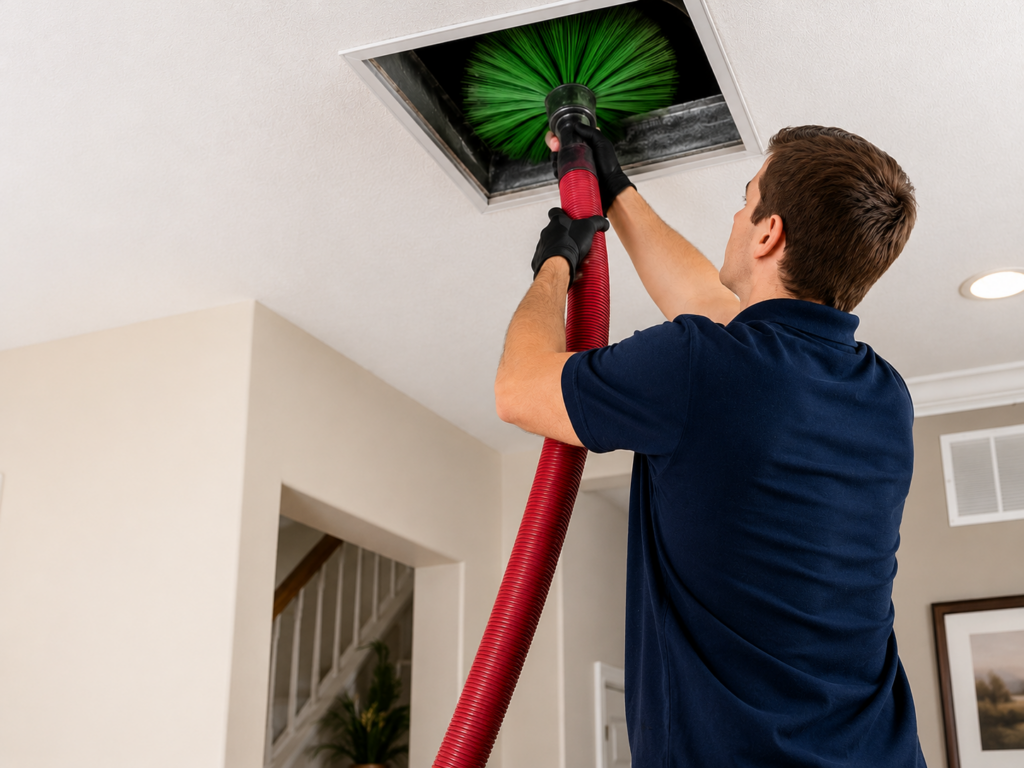 In some cases, the real cause is a leak, filtration issue, moisture problem, or another HVAC repair that needs attention first. When homeowners search “duct cleaning worth it,” they are often trying to determine whether cleaning will solve the actual problem. The question “air duct cleaning worth it” depends largely on what is found inside the system and why it became contaminated.
What Air Duct Cleaning Solves
Air duct cleaning is the physical removal of accumulated dust, debris, and other contamination from a forced-air HVAC system. A thorough service can include the supply and return ducts, registers, grilles, air-handler housing, blower components, coils, and drain pans. Simply vacuuming the visible portion of a few vents does not represent a complete HVAC-system cleaning.
The service is most useful when there is a specific contamination problem to remove. The EPA recommends considering duct cleaning when there is substantial visible mold growth on appropriate hard surfaces within the system, a rodent or insect infestation, excessive deposits of dust or debris, or particles actually being discharged from supply registers. That may include renovation debris, drywall dust, insulation fibers, pest contamination, heavy deposits of dirt, or residue associated with a past moisture problem.
A light layer of ordinary dust inside ductwork usually does not meet that threshold. Much of the material that settles inside ducts adheres to the duct surfaces, and research has not established that normal dusty ducts automatically cause elevated particle levels in the living space. That distinction matters because recurring dust can originate from filtration problems, duct leakage, building air leaks, indoor activities, pets, renovation debris, or other sources throughout the home.
The most useful way to think about duct cleaning is as a corrective service for identifiable contamination. A good cleaning removes existing contamination. When the contamination resulted from another problem, such as water intrusion or a leaking return duct, the underlying problem should be corrected as part of the solution so the ducts do not simply become contaminated again.
Benefits Of Air Duct Cleaning
The clearest benefit is removal of unwanted material that has accumulated inside a contaminated HVAC system. When ducts contain heavy deposits of construction debris, pest contamination, excessive dust, or another confirmed source of particulate matter, proper cleaning removes material that otherwise remains in the system. That can be valuable after construction or remodeling, when fine drywall dust, sawdust, insulation fibers, and other debris have entered uncovered registers or an operating HVAC system. It can also stop visible debris from being carried out of supply registers when contaminated ducts are actually contributing particles to the occupied space. These are among the clearest air duct cleaning benefits when significant contamination is present.
Cleaning can also be appropriate as part of mold remediation when mold is confirmed on cleanable HVAC surfaces and the moisture source has been corrected. Material type matters: wet or mold-contaminated fiberglass duct insulation generally requires replacement because EPA guidance indicates that it cannot be effectively cleaned in the same way as a hard duct surface.
There may also be an HVAC-performance benefit when the service includes genuinely dirty mechanical components. Research cited by the EPA suggests that cleaning contaminated cooling coils, fans, and heat exchangers may improve system efficiency. Evidence that cleaning the duct passages alone produces meaningful energy savings is limited. Potential improvements associated with cleaning dirty mechanical components are sometimes included among air duct cleaning benefits, although they depend on the condition of the system.
Cleaning may also make future HVAC problems easier to spot. Once old deposits are removed, fresh contamination becomes more informative. New insulation fibers, recurring dark residue, or rapidly returning dust can point toward an active leak, moisture source, or filtration problem.
For homeowners focused on allergies, dust, or indoor air quality, expectations should be specific to the problem found during inspection. The realistic air duct cleaning benefits depend on whether the HVAC system is actually contributing to the problem. Air duct cleaning can remove a confirmed source of contamination. Indoor air quality usually depends on several additional factors, including pollutant source control, ventilation, filtration, moisture management, and the condition of the duct system itself.
Signs Your Air Ducts Need Cleaning
One of the strongest signs is material visibly coming from the system. Dust puffs, insulation fragments, construction debris, or other particles repeatedly blowing from supply registers deserve investigation, especially when inspection reveals substantial deposits deeper inside the ductwork. EPA specifically identifies excessive debris and particles being released into the home as reasons to consider cleaning. These are among the clearest signs that air ducts need cleaning.
Another sign is unusually heavy buildup inside accessible portions of the ductwork. A thin film of settled dust is common in many systems. Thick deposits, loose debris, pest material, or buildup that can easily be disturbed by airflow indicate a different condition.
Visible mold growth inside cleanable duct surfaces or HVAC components is another reason for professional evaluation. A persistent musty odor associated with HVAC operation can also justify inspecting the ducts, coil area, drain pan, and air handler for moisture-related contamination. These moisture-related conditions can be signs that air ducts need cleaning, but the source of the moisture still needs to be corrected. Moisture deserves particular attention because mold can return after cleaning when the water, drainage, condensation, or humidity problem that allowed it to grow remains unresolved.
Evidence of rodents or insects in the duct system also warrants action. The infestation should be eliminated and entry points addressed before or alongside the removal of contaminated material.
Pay attention to how the problem is distributed through the home as well. Similar contamination at many supply registers can indicate a system-wide issue. One unusually dusty room may point toward a local duct connection, register boot, damaged section of duct, or pressure problem. Patterns like these can provide additional signs that air ducts need cleaning or that a more localized HVAC problem is responsible.
Dust on the face of a return grille is a weaker indicator by itself. Return grilles naturally collect some dust because air from the room is being pulled through them. A better diagnosis looks inside the system and asks how quickly contamination returns, whether debris is reaching the rooms, and where the material is entering the HVAC system in the first place.
How Often Should Air Ducts Be Cleaned
There is no evidence-based rule that every home’s ducts should be cleaned on a fixed two-, three-, or five-year schedule. The EPA recommends cleaning residential air ducts as needed rather than making duct cleaning a routine maintenance service. Air ducts are better cleaned according to condition than according to a calendar.
A condition-based approach is more useful. Ducts should be inspected when there is evidence of excessive contamination, visible mold, pest activity, unexplained debris coming through registers, or another event that may have introduced significant material into the system. In practice, air duct cleaning is best triggered by actual system conditions rather than elapsed time. Events are often more useful triggers than time. It makes sense to inspect the system after major remodeling, contamination from pests, water intrusion, replacement of damaged ductwork, or an unexplained increase in material coming from registers.
Two homes of the same age can have completely different duct conditions. One may have sealed ducts, good filtration, no pets, and very little contamination after many years. Another may have leaky returns in an attic, remodeling debris, filter bypass, or previous pest activity and need attention much sooner.
Once the ducts have been properly cleaned and the source of contamination has been corrected, they may remain acceptably clean for a long time. A home whose ducts were cleaned recently and already appear heavily contaminated should usually be investigated for the source of that contamination before scheduling another routine cleaning.
Regular HVAC maintenance still matters between those inspections. Filters should be checked frequently and replaced when dirty; ENERGY STAR advises checking them monthly during periods of heavy heating or cooling use and replacing them at least every three months as a general maintenance guideline. Actual replacement frequency can vary with filter type, system use, pets, household conditions, and manufacturer recommendations.
Is Air Duct Cleaning Worth It
It can be worthwhile when inspection shows that contamination inside the HVAC system is an important source of the dust or debris reaching the home. The question “duct cleaning worth it” is easiest to answer when there is a clear connection between contamination in the system and the problem inside the home. In that situation, removing the source is a sensible part of improving the indoor environment.
The evidence is much less convincing for routine duct cleaning in an otherwise normally dusty home. EPA guidance notes that studies have not conclusively shown that household particle levels generally fall after duct cleaning, partly because settled material inside ducts often remains attached to the duct surfaces. Indoor dust also comes from outdoor particles, fabrics, people and pets, cooking, cleaning, and numerous other sources. Cleaning the ducts cannot prevent those materials from being produced. That is why “air duct cleaning worth it” does not have the same answer for every home.
The type of dust matters. Visible particles being carried through the supply system, construction debris inside the ducts, deteriorating insulation, or contamination entering through a leaking return creates a reasonable connection between the HVAC system and the problem the homeowner is experiencing.
For ongoing airborne-particle control, filtration often deserves equal or greater attention. EPA guidance identifies source control and clean-air ventilation as primary indoor-air-quality strategies, with HVAC filtration and portable air cleaners serving as useful additional tools. EPA currently recommends considering a MERV 13 HVAC filter, or the highest-efficiency filter the system’s fan and filter slot can accommodate, when higher-efficiency particle filtration is desired.
When Duct Cleaning Worth It Depends On A Bigger HVAC Problem
The speed at which the ducts become dirty can be as informative as the dirt itself. Heavy contamination that returns soon after cleaning suggests that the HVAC system has an ongoing pathway allowing particles or moisture to enter.
Dirty ducts often preserve evidence of conditions elsewhere in the system. Fiberglass-like particles may come from deteriorating internal duct liner, damaged insulation, or a nearby attic source.
Where the buildup appears can also provide clues. Heavy contamination in return ducts may indicate that dirty air has been entering before it reaches the filter. Debris near a particular register may point to a local duct or boot problem. Material concentrated around the air handler may indicate filtration, bypass, or maintenance issues.
The location of the dirt is therefore important. Contamination on one side of the system can tell a different story from contamination on the other. An inspection that identifies where the buildup begins can often narrow down how it got there.
Problems Air Duct Cleaning Won’t Fix
A leaking return duct can draw dusty attic, crawlspace, basement, or wall-cavity air directly into the HVAC system. Because the leak occurs before the air reaches the blower, large amounts of unwanted material can enter without being obvious inside the occupied rooms.
Filter bypass occurs when air finds a path around the filter rather than through it. A filter that is slightly too small, a poorly sealed filter cabinet, missing access-panel seals, or gaps around a return plenum can allow unfiltered air into the blower and downstream components.
Moisture changes the problem entirely. Condensation on poorly insulated ductwork, a drain problem near the cooling coil, wet duct insulation, or elevated humidity can allow dirt to adhere to surfaces and create conditions for microbial growth. Cleaning can remove existing residue while the moisture source continues producing new contamination.
Airflow problems can also influence where dust settles. Crushed flexible ducts, restricted returns, blocked registers, dirty coils, incorrect blower settings, or poorly balanced duct systems can change velocity and pressure throughout the system. Those changes can encourage material to accumulate in particular branches or contribute to comfort and filtration problems elsewhere.
These issues can also explain symptoms that duct cleaning alone would not be expected to correct, including rooms that remain too hot or cold, unusually high heating and cooling bills, weak airflow, excessive humidity, and dust apparently returning soon after the system has been cleaned. ENERGY STAR identifies duct leakage and duct-system deficiencies among the possible causes of several of these problems.
This is why a useful duct inspection should answer more than “Are the ducts dirty?” It should determine where the contamination came from, whether the filter is properly fitted, whether the return system is sealed, whether ducts are damaged, whether moisture is present, and whether the HVAC system is moving air correctly.
Air Duct Cleaning Worth It Or Another HVAC Fix?
The appropriate service depends on what an inspection actually finds.
A strong HVAC diagnosis starts with the symptom and traces it back to its source. Before paying for duct cleaning, homeowners should be shown the contamination that justifies the service and should understand how it got there. For homeowners still searching “duct cleaning worth it,” this inspection is what separates a targeted solution from an unnecessary service. That approach turns duct cleaning into a targeted repair decision and reduces the chance of paying repeatedly for the same unresolved problem. The EPA likewise advises consumers to ask service providers to show the contamination that warrants cleaning and cautions against companies that recommend duct cleaning automatically as routine HVAC maintenance.
Choose air duct cleaning when there is a meaningful amount of material already inside the system that needs to be physically removed. Examples include construction debris, pest contamination, loose dirt, insulation fragments, or significant accumulated deposits.
Choose duct sealing when contaminants are entering through leaks or when conditioned air is escaping through poorly connected ducts. Sealing can also improve comfort and efficiency; ENERGY STAR reports that a typical home’s duct system can lose roughly 20% to 30% of the air moving through it because of leaks, holes, and poor connections.
Choose filtration corrections when contamination is appearing downstream of the filter or the existing filter is loose, undersized, poorly fitted, frequently overloaded, or inappropriate for the system.
Choose moisture correction when there is dampness, recurring musty odor, wet insulation, condensation, drainage trouble, or microbial growth.
Choose airflow diagnosis when the home also has weak vents, noisy returns, major room-to-room temperature differences, crushed flexible ductwork, unusually high static pressure, or comfort problems that persist regardless of cleaning.
Some systems need more than one service. A leaking return duct may first require sealing, followed by cleaning to remove material that was pulled inside over time. A moisture problem may require drainage or insulation repairs before contaminated materials are cleaned or replaced. A filter-bypass problem may require cabinet sealing along with cleaning of the components that were exposed to unfiltered air. In cases like these, asking “air duct cleaning worth it” is less useful than identifying which combination of services will correct both the contamination and its source.
The condition of the ductwork usually tells only part of the story. Where the contamination starts, what it consists of, and how quickly it returns can identify the HVAC correction most likely to keep the system clean.
More HVAC Maintenance Tips:
- How Often Should You Clean Your Air Ducts?
- What Homeowners Often Get Wrong About Routine HVAC Maintenance
- What Really Shortens the Life of Your HVAC System
